India now has over 900 million internet users, and businesses of every size are shifting marketing budgets online. That growth has created a huge demand for skilled digital marketers—yet, thousands of job seekers remain stuck because no one has told them which skills actually matter.
Companies in 2026 hire for demonstrated ability, not for degrees. Whether you want a job at a Bengaluru startup, freelance clients, or to grow our business, the skills needed for digital marketing are your real currency. After training 500+ students at Digisolvers, we have seen exactly which skills open doors—and which ones sit unused on a resume. This guide covers every core skill, the tools that go with each, salary ranges, a step-by-step learning roadmap, and the mistakes you must avoid.
Why Skills Matter in a Digital Marketing Career
Hiring managers at Indian digital agencies and in-house teams now post job descriptions that list tools, platforms, and measurable outcomes—not degrees. This has turned digital marketing into one of the few fields where six months of hands-on practice can outweigh postgraduate qualifications.
Digital marketing is results-driven. A campaign either delivers leads and revenue or it does not. Employers want proof of competence, not a certificate. The digital marketing career skills jobs are learnable by anyone willing to put in consistent, structured practice—and with India’s freelance economy booming on platforms like Upwork and LinkedIn, you do not even need a job offer to start earning.
Core Skills Needed for Digital Marketing
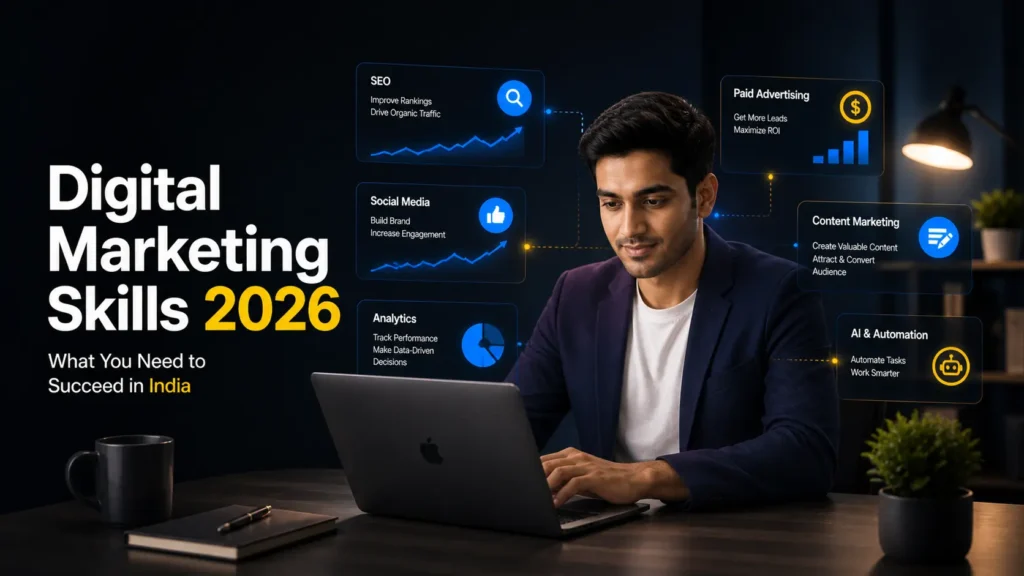
These are the foundational pillars every serious digital marketer should build. This is the digital marketing skills list employers consistently ask for in 2026.
Search Engine Optimization (SEO)
SEO is the practice of making a website appear higher on Google without paying for ads. For businesses, where consumers search everything from local restaurants to financial products before buying, SEO is not optional — it is the foundation of long-term digital visibility. A well-optimized page can bring in traffic for months or years with no ongoing spend, and that kind of compounding return is something every business owner understands.
Key areas to learn include:
- Keyword research — understanding what your audience actually types into Google
- On-page optimization — titles, meta descriptions, headers, and internal linking
- Technical SEO — site speed, mobile usability, crawlability, and Core Web Vitals
- Link building — earning backlinks from credible, relevant websites
Tools to learn: Google Search Console (free, essential) and Ahrefs or Semrush for deeper keyword and competitor analysis.
Paid Advertising — Google Ads and Meta Ads
Paid advertising, often called PPC (pay-per-click), puts your message directly in front of people searching or likely to be interested. Google Ads targets users mid-search, while Meta Ads (Facebook and Instagram) targets users based on interests, behavior, and demographics. This is one of the highest-earning skills in digital marketing because it directly controls a business’s revenue.
What to focus on:
- Understanding match types, Quality Score, and bidding strategies in Google Ads
- Building audience segments and creative strategy for Meta campaigns
- Reading campaign data and optimizing for cost-per-lead or ROAS (return on ad spend)
Tools: Google Ads Manager, Meta Ads Manager, Google Analytics 4.
Social Media Marketing
Social media marketing means building an audience, creating content that resonates, and converting followers into customers. In India, Instagram and LinkedIn are the two platforms that matter most right now. The skill here is not just posting regularly. It is understanding how each platform’s algorithm works, what content formats drive reach and engagement, and how to use analytics to improve your strategy over time.
Content Marketing
Content marketing is the engine behind SEO, social media, and email. It covers blog writing, copywriting, video scripts, landing page copy. As someone learning the skills needed to become a digital marketer, you should develop the ability to write clearly, structure information logically, and adapt your tone to different audiences. Writers with SEO knowledge are among the most hireable people in the industry.
Email Marketing
Email remains one of the highest-ROI channels, especially for e-commerce, SaaS, and education businesses. Learning how to build a subscriber list, write subject lines that get opened, segment audiences for personalized messaging, and set up automation sequences that nurture leads without manual effort.
Tools to learn: Mailchimp, ConvertKit, or ActiveCampaign for automation and segmentation.
Technical Skills vs Soft Skills in Digital Marketing
Most guides list the technical skills and stop there. The professionals who grow fastest combine technical ability with strong human skills.
Technical Skills
The hard, teachable capabilities employers test for directly:
- SEO: Keyword research, on-page optimization, technical audits
- Paid Ads: Campaign setup, audience targeting, bid management, conversion tracking
- Analytics: Google Analytics 4, attribution models, Looker Studio reporting
- Marketing Automation: Setting up email sequences, lead scoring, CRM integration
- Basic design: Canva or Adobe Express for social graphics and ad creatives
Soft Skills
What turns a technically capable marketer into someone clients trust with real budgets.
- Communication: explaining campaign results clearly and confidently
- Creativity: finding fresh angles for content and ads in crowded markets
- Analytical thinking: understanding what data is actually telling you
- Adaptability: adjusting quickly as algorithms and platforms evolve
The marketers who charge the highest freelance rates in India are rarely the most technically gifted. They are the ones who communicate clearly, deliver on time, and think strategically.
Skills Required for Digital Marketing Jobs in India
From our experience training students at Digisolvers, the most demanded skills for entry-level roles in 2026 are SEO fundamentals, Meta Ads setup, basic content writing, and familiarity with Google Analytics 4. Candidates who walk in with even one live project consistently outperform candidates with only theoretical knowledge.
Here is what companies actually look for in freshers:
- Practical exposure to at least one paid or organic channel
- Ability to read and interpret basic analytics data
- Understanding of how a marketing funnel works
- Writing ability — even one well-written blog post demonstrates this
The biggest skill gap we see in freshers is the gap between classroom knowledge and real execution. They can define SEO but have never actually optimized a page. They know what A/B testing is but have never run one. Employers spot it instantly.
Tools You Must Learn for Each Skill
Knowing the theory is one thing. Knowing which digital marketing tools to use — and how to use them efficiently — is what makes you employable. Here is a practical skill-to-tool mapping for 2026:
| Skill | Primary Tools | Purpose |
| SEO | Google Search Console, Ahrefs | Keyword tracking, audits, backlinks |
| Google Ads | Google Ads Manager, GA4 | Campaign, conversion tracking |
| Meta Ads | Meta Ads Manager, Meta Pixel | Targeting, creative testing |
| Social Media | Meta Business Suite, Buffer | Scheduling, analytics |
| Email Marketing | Mailchimp, ConvertKit | Automation, segmentation |
| Analytics | Google Analytics 4, Looker Studio | Traffic analysis, reporting |
| Content | SurferSEO, Grammarly, Canva | SEO writing, editing, design |
You do not need to master all of these at once. Pick one channel—SEO or Meta Ads is a strong starting point—and go deep on the tools for that channel before branching out.
AI and Future Skills in Digital Marketing (2026)
AI tools are now embedded in content creation, ad optimization, and audience segmentation. AI has not replaced digital marketers — it has changed what good marketers spend their time on. The AI skills in digital marketing that matter most in 2026 are about using these tools intelligently to work faster and smarter, not about becoming a data scientist.
Key AI and skills to develop in 2026:
- Prompt engineering: writing effective prompts for ChatGPT, Claude, or Gemini to produce first drafts and campaign ideas
- AI-assisted content: Using tools like Jasper as a starting point, then editing for accuracy and brand voice
- Automated ad optimization: Letting Google’s Smart Bidding or Meta’s Advantage+ while focusing on strategy and creative
- Conversational marketing: Integrating AI-powered chat tools into landing pages and WhatsApp for India-specific lead nurturing
The future skills for digital marketing careers are not about replacing human judgment — they are about amplifying it. A marketer who understands AI tools but still brings strategic thinking, creativity, and real-world context will always outperform one who relies on AI without understanding the fundamentals.
Step-by-Step Roadmap to Learn Digital Marketing Skills
Here is a practical, three-month digital marketing skills guide – how to learn digital marketing skills step by step without wasting time jumping between topics.
Month 1 — Foundations and Concepts
- Understand how search, social, email and paid channels work together
- Learn basic SEO — how Google ranks pages, what keywords are, how to structure content
- Set up a free Google Search Console and GA4 accounts for a test website
- Study one social platform deeply based on your target audience
Month 2 — Tools and Practical Execution
- Run a small Google Ads campaign—even Rs. 500 teaches the fundamentals
- Write and publish three SEO-optimized blog posts and track performance
- Build a basic email sequence using a free Mailchimp account
- Complete one free certification: Google’s Skillshop, Meta Blueprint, or HubSpot Academy
Month 3 — Real World Experience
- Apply for a digital marketing internship—many startups hire with basic skills
- Offer a free project to a local business in exchange for a testimonial and results data
- Choose a primary specialization: SEO, paid ads, social media, or content
- Build a simple portfolio page showing two to three projects with real metrics
You do not need three months if you are consistent. Some Digisolvers students have landed their first freelance projects within six weeks by focusing on one skill and executing relentlessly.
Salary Based on Digital Marketing Skills in India
Salary varies significantly by specialization and whether you are employed or freelancing. The highest-paying digital marketing skills are performance marketing roles—Google Ads and Meta Ads—because they have a direct, measurable impact on revenue.
| Role / Specialization | Entry-Level Salary | Experienced / Freelance |
| SEO Specialist | Rs. 2.5–4 LPA | Rs. 6–12 LPA / Rs. 30–80k/month freelance |
| Google Ads Specialist | Rs. 3–5 LPA | Rs. 7–15 LPA / Rs. 40–1L+/month freelance |
| Social Media Manager | Rs. 2.5–4 LPA | Rs. 5–10 LPA / Rs. 25–60k/month freelance |
| Content Marketer | Rs. 2.5–4 LPA | Rs. 5–9 LPA / Rs. 20–60k/month freelance |
| Digital Marketing Manager | Rs. 5–8 LPA | Rs. 12–25 LPA |
Common Mistakes Beginners Make
- Learning only theory: Watching hours of tutorials without ever running a campaign or writing a live blog post.
- Ignoring analytics: Posting content or running ads without reviewing what the numbers are telling you
- Trying to learn everything at once: go deep on one channel before branching out
- Not building a portfolio: a single well-documented project with real metrics is worth ten certifications
- Chasing shortcuts: tools that promise to ‘automate SEO’ or ‘10,000 followers overnight’ waste your time and money
How to Learn These Skills Faster — Without Wasting Time
A structured course with mentorship compresses the timeline. When an experienced practitioner can tell you exactly why your SEO article is not ranking or why your Meta campaign is underperforming, you fix in days what might take months to figure out alone. Three principles matter most regardless of which path you choose:
- Practice on live projects, not dummy exercises—even a friend’s business counts
- Review your results every week and ask why things worked or did not work
- Stay connected to a community of practitioners who share what is actually working now
At Digisolvers, our training is built entirely around live execution and mentorship. If you want a structured path to becoming job-ready or freelance-ready, explore our digital marketing course
Real Questions Beginners Ask—Answered Honestly
Q: Do I need coding for digital marketing?
No. A basic understanding of HTML — enough to edit a meta tag or add an alt text attribute — is helpful, but you will not need to write code. Tools like WordPress and Shopify handle the technical side without any coding knowledge.
Q: Which digital marketing skill is best for beginners?
SEO is the best starting point. It teaches you how search engines work, how to create content people are looking for, and how to measure results—knowledge that applies across every other channel. Social media marketing is a strong second if you prefer creative, visual work.
Q: How long does it take to learn digital marketing?
You can develop job-ready, entry-level skills in three to six months with consistent daily practice. the kind of proficiency that commands higher salaries or strong freelance rates typically takes twelve to eighteen months of hands-on work.
Q: Which skill pays the highest salary in digital marketing?
Performance marketing — specifically Google Ads and Meta Ads management — tends to pay the highest salaries because it has a direct, measurable connection to revenue.
Your Digital Marketing Journey Starts With One Skill
Digital marketing in India is not slowing down — and the skills needed for digital marketing are more accessible today than ever. Build a foundation in SEO and at least one paid channel, develop your content and analytical abilities, get comfortable with the tools, and start building a portfolio from your very first week of learning. Add AI literacy on top of that, and you will be better prepared than the majority of candidates entering the market right now.
A digital marketing career rewards action over perfection. You do not need to know everything before you start. You need to start — with clarity on which skill you are building first, a commitment to real practice, and the patience to let results compound over time.