
Digisolvers

Other

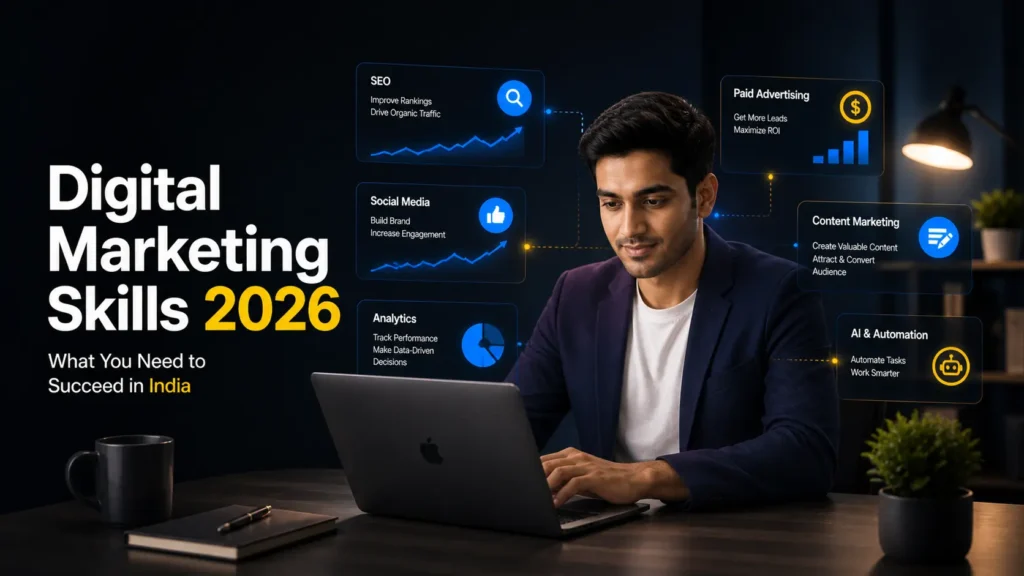
Digital marketing skills needed for success in India 2026, featuring SEO, AI, and social media analytics icons.
Other

Skills Needed for Digital Marketing in India (2026 Guide)

India now has over 900 million internet users, and businesses of every size shifting marketing budgets  online. That growth has created a huge demand for skilled digital marketers- yet, thousands of job seekers remain stuck because no one has told them which skills actually matter. Companies in 2026 hire for demonstrated ability, not degrees. Whether you want a job at a Bengaluru startup, a freelance clients, or to grow our business, the skills needed for digital marketing are your real currency. After training 500+ students at Digisolvers, we have seen exactly which skills open doors- and which ones sit unused on a resume. This guide covers  every core skill, the tools that go with each, salary ranges, a step-by-step learning roadmap, and the mistakes you must avoid. Why Skills Matter in a Digital Marketing Career Hiring managers at Indian digital agencies and in-house teams now post job descriptions that list tools, platform, measurable outcomes — not degrees. This has turned digital marketing into one of the few fields where six months of hands-on practice can outweigh postgraduate qualification. Digital marketing is results-driven. A campaign either delivers leads and revenue or it does not. Employers want proof of competence, not a certificate. The digital marketing career skills jobs are learnable by anyone willing to put in consistent, structured practice — and with India’s freelance economy booming on platforms like Upwork and LinkedIn, you do not even need a job offer to start earning. Core Skills Needed for Digital Marketing These are the foundational pillars every serious digital marketer should build. This is the digital marketing skills list employers consistently ask for in 2026. Search Engine Optimization (SEO) SEO is the practice of making a website appear higher on Google without paying for ads. For businesses, where consumers search everything from local restaurants to financial products before buying, SEO is not optional — it is the foundation of long-term digital visibility. A well-optimized page can bring in traffic for months or years with no ongoing spend- and that kind of compounding return is something every business owner understands. Key areas to learn include: Keyword research — understanding what your audience actually types into Google On-page optimization — titles, meta descriptions, headers, and internal linking Technical SEO — site speed, mobile usability, crawlability, and Core Web Vitals Link building — earning backlinks from credible, relevant websites Tools to learn: Google Search Console (free, essential), Ahrefs or Semrush for deeper keyword and competitor analysis. Paid Advertising — Google Ads and Meta Ads Paid advertising, often called PPC (pay-per-click), puts your message directly searching or likely to be interested. Google Ads targets users mid-search, while Meta Ads (Facebook and Instagram) targets users based on interests, behaviour, and demographics. This is one of the highest-earning skills in digital marketing because it directly controls a business’s revenue. What to focus on: Understanding match types, Quality Score, and bidding strategies in Google Ads Building audience segments and creative strategy for Meta campaigns Reading campaign data and optimizing for cost-per-lead or ROAS (return on ad spend) Tools: Google Ads Manager, Meta Ads Manager, Google Analytics 4. Social Media Marketing Social media marketing means building an audience, creating content that resonates, and converting followers into customers. In India, Instagram and LinkedIn are the two platforms that matter most right now. The skill here is not just posting regularly. It is understanding how each platform’s algorithm works, what content formats drive reach and engagement, and how to use analytics to improve your strategy over time. Content Marketing Content marketing is the engine behind SEO, social media, and email. It covers blog writing, copywriting, video scripts, landing page copy. As someone learning the skills needed to become a digital marketer, you should develop the ability to write clearly, structure information logically, and adapt your tone to different audiences. Writers with SEO knowledge are among the most hireable people in the industry. Email Marketing Email remains one of the highest-ROI channels, especially for e-commerce, SaaS, and education businesses. Learning how to build a subscriber list, write subject lines that get opened, segment audiences for personalized messaging, and set up automation sequences that nurture leads without manual effort. Tools to learn: Mailchimp, ConvertKit, or ActiveCampaign for automation and segmentation. Technical Skills vs Soft Skills in Digital Marketing Most guides list the technical skills and stop there. The professionals who grow fastest combine technical ability with strong human skills. Technical Skills The hard, teachable capabilities employers test for directly: SEO: Keyword research, on-page optimization, technical audits Paid Ads: Campaign setup, audience targeting, bid management, conversion tracking Analytics: Google Analytics 4, attribution models, Looker Studio reporting Marketing Automation: Setting up email sequences, lead scoring, CRM integration Basic design: Canva or Adobe Express for social graphics and ad creatives Soft Skills What turns a technically capable marketer into someone clients trust with real budgets. Communication: explaining campaign results clearly and confidently Creativity: finding fresh angles for content and ads in crowded markets Analytical thinking: understanding what data is actually telling you Adaptability: adjusting quickly as algorithms and platforms evolve The marketers who charge the highest freelance rates in India are rarely the most technically gifted. They are the ones who communicate clearly, deliver on time, and think strategically. Skills Required for Digital Marketing Jobs in India From our experience training students at Digisolvers, the most demanded skills for entry-level roles in 2026 are SEO fundamentals, Meta Ads setup, basic content writing, and familiarity with Google Analytics 4. Candidates who walk in with even one live project— consistently outperform candidates with only theoretical knowledge. Here is what companies actually look for in freshers: Practical exposure to at least one paid or organic channel Ability to read and interpret basic analytics data Understanding of how a marketing funnel works Writing ability — even one well-written blog post demonstrates this The biggest skill gap we see in freshers is the gap between classroom knowledge and real execution. They can define SEO but have never actually optimized a page. They
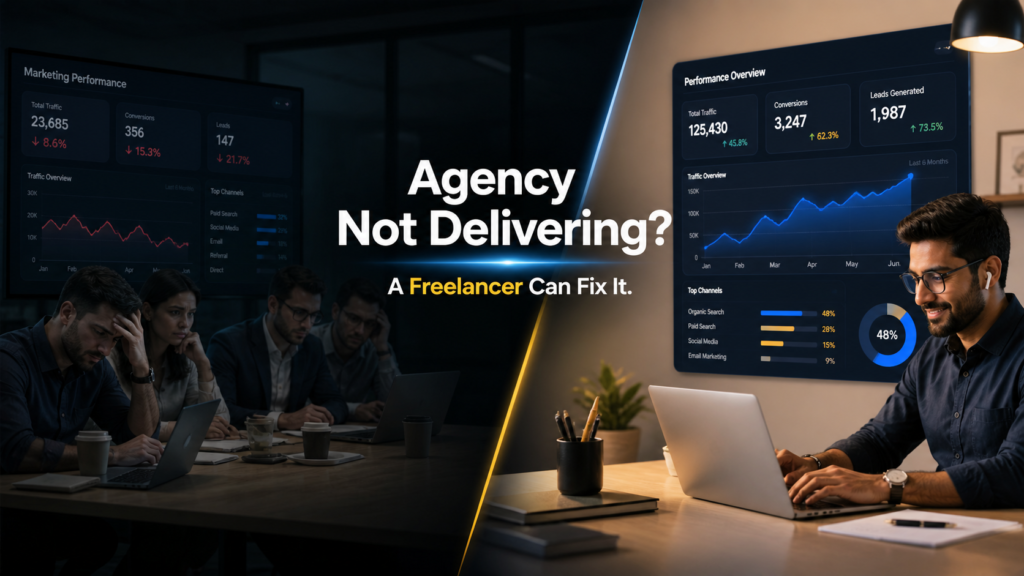
freelance digital marketing comparison showing struggling agency team with declining performance versus freelancer achieving growth with analytics dashboard and increasing results
Other

Why Your Digital Marketing Agency Isn’t Delivering—And What a Freelancer Can Fix Instead

If you’re looking for freelance Digital marketing solutions, you’ve come to the right place. Many small businesses struggle with their agency partnerships, and understanding why a Digital marketing agency fails to meet clients’ needs can help you pivot wisely. In this post, we’ll explore the common pitfalls of agencies, compare agency vs freelancer marketing, and show how an independent Performance marketing expert can transform your efforts. 1. The Unseen Problem: When a Digital Marketing Agency Fails Clients If you’re looking for freelance Digital marketing solutions, you’ve come to the right place. Many small businesses struggle with their agency partnerships, and understanding why a Digital marketing agency fails to meet clients’ needs can help you pivot wisely. In this post, we’ll explore the common pitfalls of agencies, compare agency vs freelancer marketing, and show how an independent Performance marketing expert can transform your efforts. 1.1 Misaligned expectations and vague goals First off, agencies sometimes onboard clients without fully clarifying measurable goals. If your agency hasn’t defined what success looks like (leads, sales, brand awareness), how will you know if they delivered? Without clear KPIs and alignment, the agency vs. freelancer marketing battle already begins in your mind. 1.2 Cookie-cutter strategies vs business-specific tactics A frequent issue: the agency rolls out a generic plan that “works for everyone”. But your business is unique. If the strategy is one-size-fits-all, you’ll see mediocre outcomes. Custom Performance marketing strategies for small businesses are what actually move the needle—yet agencies may not invest the time. 1.3 Low transparency and communication gaps When an agency acts like a black box—monthly report arrives, vague commentary, no real-time updates—you feel disconnected. You might sense “why agencies fail clients” because you’re not in the loop. A strong relationship depends on clear, consistent communication. 1.4 Over-promotion of “everything” rather than focusing Many agencies pitch full-service bundles (SEO + social + ads + content) without evaluating which will truly drive your results. This scatter approach dilutes effort. On the contrary, affordable freelance marketing support typically allows you to pick the most relevant channels and focus. 1.5 Budget and resource mismatch Agencies have overhead: teams, tools, and account managers. Sometimes they assign junior people or spread resources across many clients. Results may lag. A freelancer often has fewer layers and can pivot faster. 1.6 Long waiting times and slow feedback loops When you need a change, you might wait days or weeks for your agency to act. This can be critical in fast-moving online markets. Meanwhile, an independent Performance marketing expert can respond swiftly. 1.7 Lack of ownership and accountability Finally, agencies might shrug when things don’t move. They may say “we did our part”. When you ask, “Why are the numbers flat?”, you feel you got promises, not performance. This is a core reason why Performance marketing agency failure occurs. 2. Agency vs Freelancer: What the Comparison Reveals If you’re wondering whether to stay with your agency or switch to a freelancer, this clear comparison will help. 2.1 Cost and value Agency: Higher cost due to overhead; you may pay for tools and structures you don’t fully use. Freelancer: Typically lower cost, more flexible; you get freelance online marketing services without heavy overhead. 2.2 Flexibility and responsiveness Agency: Procedures and hierarchies mean slower turnaround. Freelancer: Faster decision-making, fewer people to go through. If you want to test a new idea today, a freelancer can often implement it tomorrow. 2.3 Customization and attention Agency: Might rely on templated campaigns, standard reports, and general strategies. Freelancer: Can craft truly custom Performance marketing strategies for small businesses; this means the tactics are tailored for your business, audience, budget, and goals. 2.4 Accountability and communication Agency: You may have an account manager, plus project manager, plusan  execution team, which dilutes accountability. Freelancer: You deal directly with the person doing the work. That builds trust and ensures clarity. 2.5 Ownership of work Agency: Sometimes your work goes into a shared pool; priority may go to bigger clients. Freelancer: Your project tends to become the main focus. You get more ownership and personal investment. 2.6 Strategy vs execution — who drives what? Agency: Might propose large campaigns without deeply understanding your business. Freelancer: Being independent, they often live and breathe your niche. By hiring a freelance Performance marketer for result-driven online growth, you align strategy with real business goals. Because of these factors, many businesses find switching to the best freelance Performance marketing solutions for small businesses to be a smart move. 3. Why Agencies Fail Clients (and How to Avoid Their Traps) Understanding the specific reasons for failure helps you recognize red flags. Here are deeper insights and remedies. 3.1 Lack of business-context understanding Agencies sometimes treat your business like any other. They don’t ask deep questions about your audience, product lifecycle, competition, or culture. When that happens, your campaigns feel generic. Instead, an independent Performance marketing expert integrates with your business, asks the right questions, and designs strategies accordingly. 3.2 Too many changing priorities Agencies serve multiple clients, chase new pitches, and shift resources. For your business, this means one day you’re top priority, the next day you’re not. That inconsistency impacts results. With freelance Performance marketing solutions, the freelancer takes a stable, committed role for your business. 3.3 Linear workflows, but Performance marketing is iterative Many agencies operate linearly: kickoff → execute → report → rinse. But Performance marketing for small businesses needs iteration, testing, and adjustment. Without that, you’ll keep doing the same things and expect new results. A freelancer offers agile workflows that adapt fast. 3.4 Metrics without meaningful insight An agency might report “50 % traffic increase,” but if the traffic isn’t converting, you’re no better off. Or they may hide low conversion rates. An independent Performance marketing expert focuses on meaningful metrics and ensures your growth is measurable. 3.5 Poor internal alignment Inside the agency: strategy team, creative team, execution team. These can miscommunicate and cause gaps. You’re left with a marketing machine that delivers mismatched parts. When you work

Scroll to Top